When analytics looks right but your budget goes the wrong way.
Business Objective → Measurement Architecture → Optimization Signal → Algorithmic Behavior
Measurement architecture decides whether you get paying customers or activity.
What will you find here?
Here you will find the framework of measurement architecture: how Consent Mode, Google Tag Manager (GTM), and Google Analytics 4 (GA4) together form the optimization signal that drives decisions, budget, and automation. The focus is on value-based measurement: conversion and value are defined so that optimization aims at business objectives and improving profitability, not just conversion volume.
The optimization signal determines what the systems begin to favor.
In the articles, I analyze measurement architecture in practice: how optimization signals are formed, how they drive automation, and what kind of decision risks arise when measurement looks correct but the signal is wrong.
Who is this for?
This is for you if you use data for decisions or to drive automation. Especially when budget is being allocated, campaigns optimized, or results evaluated based on reports. Measurement architecture makes these decisions more reliable, because it determines what kind of optimization signal ultimately remains available for the systems to use.
What do I do in practice?
I define the business objective as an optimization signal, build controlled data collection, and ensure that conversion and value steer budget and automation toward the right outcome. My role is to implement and help implement measurement architecture that translates business objectives into digital signals that can be used in decision-making, budget allocation, and automation. This combines technical control, correct meaning, and privacy into a coherent whole that supports decision-making.
Layers of Measurement Architecture
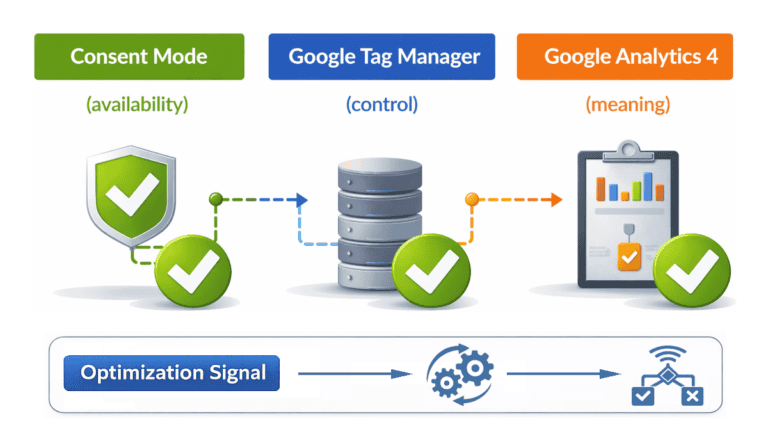
Consent Mode (availability) → Google Tag Manager (control) → Google Analytics 4 (meaning) = optimization signal

Consent Mode – Signal availability
How to ensure data legality and model missing information

Google Tag Manager – Signal control
Signal control How to manage the technical origin and quality of data

Google Analytics 4 – Signal meaning
Signal meaning How to turn raw data into conversions and decisions
Optimization Signal
When availability, control, and meaning combine, an optimization signal emerges.
The optimization signal determines what algorithms learn, what kind of traffic they begin to favor, and where budget is allocated.
Recommended articles
Articles analyzing measurement architecture, optimization signals, and decision risks in real analytics implementations.